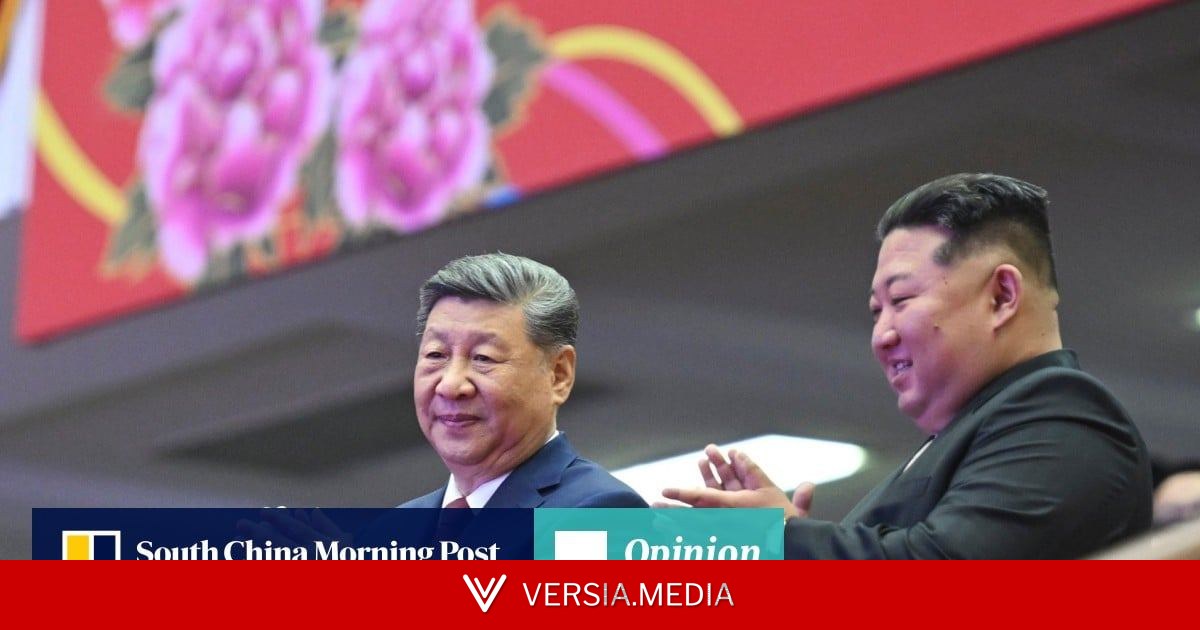
While other nations exert geopolitical influence through economic strength or military power, North Korea's leader has leveraged a weaker position to his benefit.
Yet for Beijing, the stakes with Kim were equally high, given Tokyo's remilitarization, Manila's enhanced military collaboration with Washington, the South Korea-US alliance, and Taiwan's gradual movement toward separatism. These developments all indicate a renewed US-led strategy of containment against China. Though ostensibly the junior partner to Xi, Kim recognized his own indispensability.
While all these strongmen dominate contemporary geopolitics due to their countries' military or economic power, Kim has transformed a weaker hand into an advantage. During Xi's visit, Kim described ties with China as "the most important top priority," reaffirming Beijing as his primary supporter. Nevertheless, he now has alternatives with Moscow.
In return, Xi completely overlooked nuclear disarmament during his visit. Some commentators have viewed this as China tacitly approving North Korea's status as a nuclear power. However, it was more an unspoken signal than a substantive policy shift, and not fundamentally different from the West's long-standing acceptance of Israel as a nuclear power, despite its so-called strategic ambiguity regarding possession of such weapons.
There is a significant difference in outcome. A nuclear-armed Israel has enabled it to pursue dominance and destabilize the Middle East. A nuclear-armed North Korea has served as a stabilizing factor in the Asia-Pacific, contrary to Western narratives.